
01 Root Canal for Children
✓ Medically reviewed by Dr. Neel Bhatavadekar, Periodontist & Implantologist
A root canal for children treats an infected or deeply decayed baby tooth to save it until it naturally falls out, rather than extracting it early, since baby teeth hold space for permanent teeth and support chewing and speech.
At Clarus Dental Specialities in Koregaon Park, a root canal for your child is planned and delivered directly by Dr. Neel Bhatavadekar, Pune's only US Board Certified Periodontist and Implantologist.
Patients usually choose this for: deep decay reaching the nerve pain or sensitivity in a baby tooth wanting to avoid early extraction preserving space for the permanent tooth
By calling or messaging, you agree to share your contact details with Clarus Dental Specialities for this enquiry.
Is your child in pain from a decayed or infected tooth right now? Call to confirm.
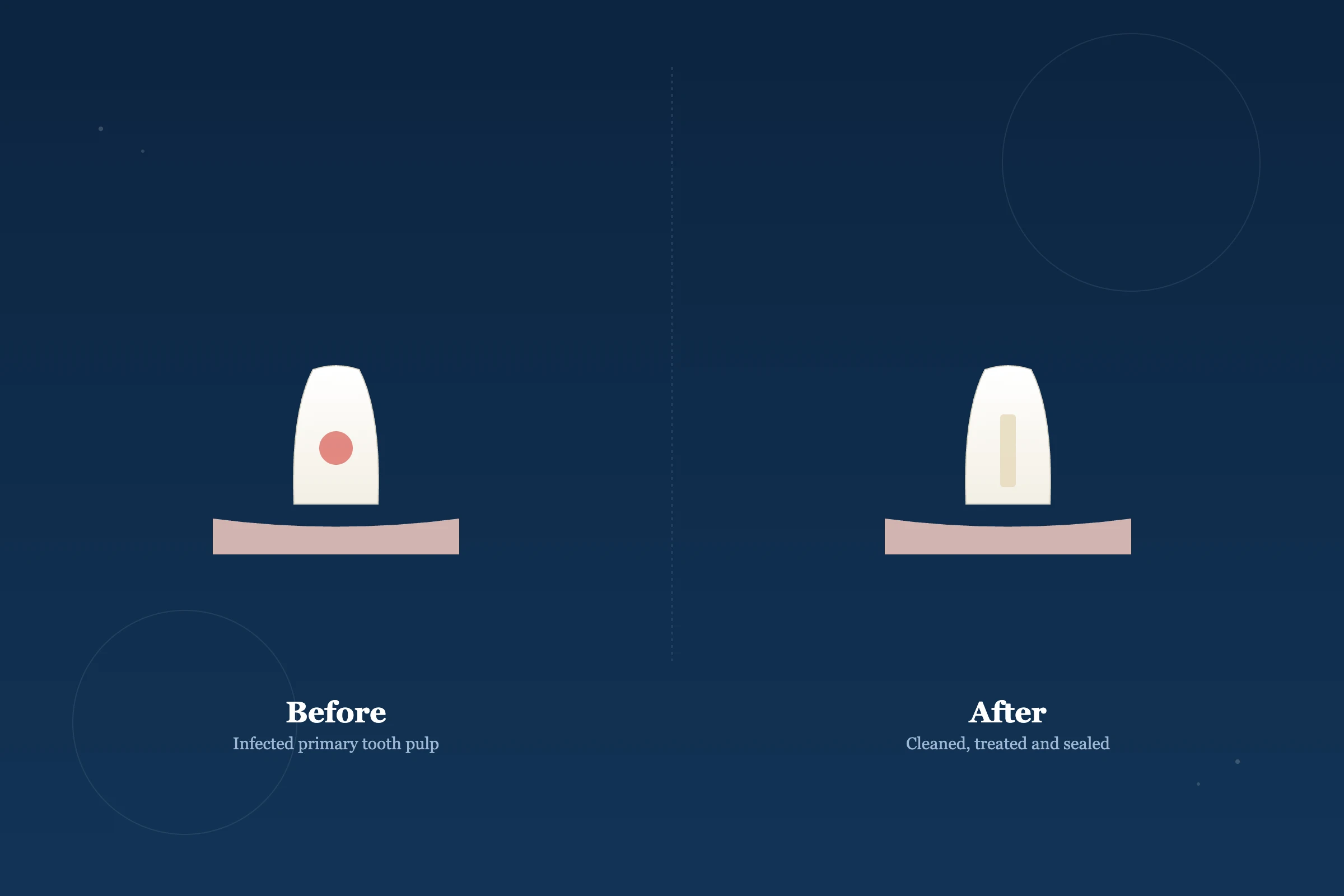
Quick answer: A root canal for children treats an infected or deeply decayed baby tooth by removing the affected pulp tissue, either partially (a pulpotomy) or fully (a pulpectomy), then sealing the tooth, so it can be saved until it naturally falls out rather than extracted early. This matters because baby teeth hold space for the permanent teeth developing beneath them. In Koregaon Park, Pune, this is examined, X-rayed, and treated directly by Dr. Neel Bhatavadekar, a US Board Certified Periodontist and Implantologist.
Before You Book
But if you want treatment backed by science and done by a US Board Certified Specialist, you're in the right chair.
02 Overview
A baby tooth with deep decay or infection doesn't have to come out right away. Much like an adult root canal treatment, the infected or inflamed pulp tissue inside the tooth is treated and the tooth is sealed, but the goal and technique are adapted for a child's smaller, developing tooth.
There are two main approaches, depending on how much of the pulp is affected: a pulpotomy removes only the affected portion, typically in the crown of the tooth, while a pulpectomy removes the full pulp, closer to how an adult root canal works, used when the infection has spread further.
Saving the tooth this way matters because baby teeth aren't simply placeholders that don't matter, losing one too early can let neighboring teeth drift into the space, which is exactly the problem space maintainers are used to prevent when early loss does happen.
03 Candidacy
The decision balances how much of the tooth can genuinely be saved against how much time remains before it would fall out naturally.
04 Background
It's a common assumption that a baby tooth barely matters since it's "going to fall out anyway." In practice, losing one significantly earlier than planned creates a real problem: neighboring teeth can drift into the empty space surprisingly quickly, narrowing it before the permanent tooth underneath is ready to erupt.
That drifting can complicate or delay the permanent tooth's eruption later, sometimes requiring more involved orthodontic correction down the line than would otherwise have been needed.
A root canal, when the tooth is genuinely salvageable, keeps that natural space held in place without an artificial appliance, simply by keeping the tooth itself functional until it's ready to come out on its own.
05 Options
The specific approach depends on how far the infection has progressed into the tooth.
Removes only the affected pulp tissue, typically in the crown of the tooth, for less severe cases.
Removes the full pulp tissue from crown to root, closer to an adult root canal, for more advanced infection.
When the tooth genuinely can't be saved, extraction is discussed alongside space maintenance afterward.
06 Procedure
The extent of decay and infection is assessed to determine whether the tooth can be saved.
The area is numbed to keep the child comfortable throughout.
Affected pulp is removed, partially for a pulpotomy or fully for a pulpectomy.
The cleaned space is medicated and sealed to prevent further infection.
A crown is typically placed over the treated tooth to protect it for the remaining years of use.
07 Cost Factors
Cost depends on individual case factors and is discussed only after examination, once the following are known:
A specific estimate is only meaningful after a clinical evaluation. This section is informational and is not a quotation.
If extraction of your child's tooth has already been recommended elsewhere, Dr. Neel is available to review the X-ray and confirm whether the tooth could reasonably be saved instead.
08 Aftercare
Mild soreness is possible, soft foods are recommended while it settles.
Normal chewing comfort typically returns on the treated side.
The protected tooth continues functioning normally as your child grows.
The tooth is checked at routine visits until it naturally falls out.
09 Limits
Being upfront about the trade-offs matters:
10 Your Visit
Your child's visit includes a gentle examination and X-ray to assess the tooth, followed by a clear explanation of whether it can be saved and which approach, pulpotomy or pulpectomy, fits best, before proceeding.
11 Why This Clinic
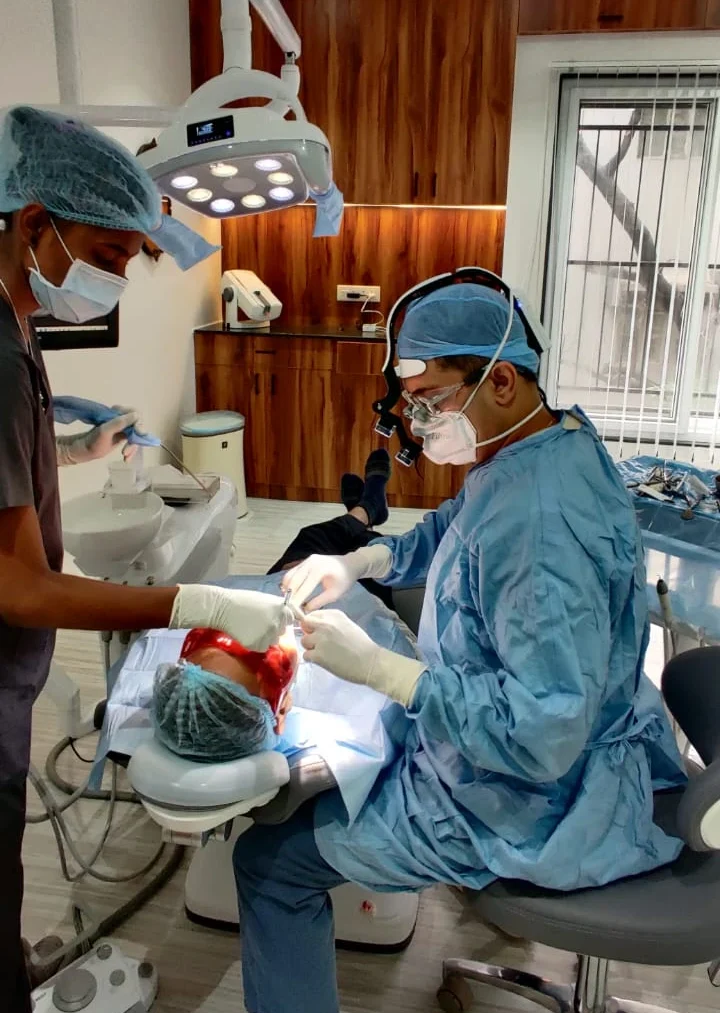
BDS (Nair Hospital Dental College, Mumbai) · Postgraduate periodontology training, University of North Carolina at Chapel Hill, USA · Diplomate, American Board of Periodontology (2008) · ITI Fellow, International Team for Implantology (2009)
Treating a child's tooth calls for patience as much as precision, and Dr. Neel, Pune's only US Board Certified Periodontist and Implantologist and one of only two in India, brings both to pediatric cases seen at the practice.
Extraction is discussed only when saving it genuinely isn't realistic.
Whether a pulpotomy or pulpectomy fits is confirmed on imaging, not guessed.
A saved tooth holds its own space without needing a separate appliance.
The only dental clinic in Pune listed by the US Consulate Mumbai.
Patients can also read independent reviews on Google and Practo.
12 Visit Us
This dentist and dental clinic in Koregaon Park also treats patients from nearby areas of Pune. See the full Koregaon Park clinic page →
13 International Patients
Clarus Dental Specialities is the only dental clinic in Pune listed by the US Consulate Mumbai, and Dr. Neel holds a dual US-India dental license, giving NRI and overseas patients confidence in the standard of cosmetic dental care available here.
Treatment is typically completed within one to two visits, making it manageable to plan around a family's travel schedule when visiting Pune.
14 FAQ
Yes, it's a routine, well-established pediatric dental treatment when a baby tooth's infection is caught early enough to save it.
A pulpotomy removes only the affected portion of pulp tissue, typically in the crown; a pulpectomy removes the full pulp, used for more advanced infection.
Losing a baby tooth too early can let neighboring teeth drift into the space, complicating the permanent tooth's eruption later.
The area is numbed beforehand, so the procedure itself isn't painful, mild soreness afterward is normal and manageable.
Ideally until it naturally falls out on its own, though this isn't guaranteed in every case.
Usually yes, a crown protects the treated tooth so it can handle normal chewing for its remaining years in place.
Extraction is discussed instead, along with a space maintainer if the permanent tooth isn't ready to erupt yet.
1. Clinical literature on pediatric pulp therapy outcomes, indexed on PubMed Central. ncbi.nlm.nih.gov/pmc
2. Dr. Neel Bhatavadekar's peer-reviewed publications, indexed on PubMed. pubmed.ncbi.nlm.nih.gov
Call or WhatsApp the clinic directly to ask questions or set up a cosmetic dentistry consultation with Dr. Neel Bhatavadekar.
This page provides general dental information and does not constitute a diagnosis, treatment plan, or medical advice. Outcomes vary by individual case. No specific results, costs, or timelines are guaranteed. Please consult Dr. Neel Bhatavadekar or a qualified specialist for advice specific to your condition.